
How to Choose the Best TMS for Your Fleet
We hear this question everywhere: on calls, in conference halls, and across LinkedIn:
“What’s the best TMS out there?”
It usually comes right after someone says:
“We’ve outgrown our current system,” or
“Our TMS contract is up, and we’re not sure it’s working for us anymore.”
It’s a fair question. Every trucking company wants to make the right call before investing more time and money into software that’s supposed to make life easier, not harder.
And every time, our answer is the same:
It depends.
That’s not a cop-out. It’s the truth.
Because the best TMS depends on how you run, what you haul, where your business is headed… and where you’re starting from.
1. It Starts with How You Operate
A Transportation Management System (TMS) built for a 50-truck regional fleet may not fit a 250-truck OTR operation — and it might be overkill for a 10-truck local hauler.
Your operation type shapes your needs:
Asset-based carriers need tools built for dispatch, drivers, and equipment.
Hybrid fleets need seamless support for both assets and brokerage.
Freight-specific workflows matter - what works for fuel haulers may not work for reefer, flatbed, or specialized carriers.
The key is finding a system designed around your kind of freight and how your team runs it.
2. There’s No “One-Size-Fits-All”
At GLCS, we’ve worked with fleets of every size, and one truth stands out:
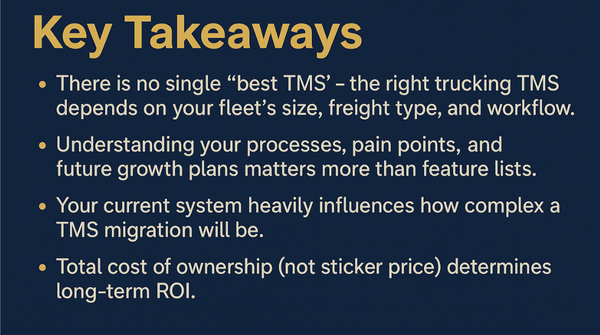
No single trucking TMS works for everyone.
Some platforms are perfect for smaller fleets wanting simplicity.
Some excel for mid-sized carriers that need automation and visibility.
A few are built for complex, multi-terminal enterprise operations.
Think of it like spec’ing trucks: what works for a local bulk hauler isn’t the same setup an OTR dry van fleet needs.
The same logic applies here.
3. Know What Actually Matters and Get Your Team Involved Early
Before booking demos, take time to understand where your operation truly struggles and ask the people who use the system every day.
Talk to dispatch, billing, safety, and operations:
Where do we lose time or visibility?
Are we double-entering data?
Which tasks still happen in spreadsheets?
What do drivers call in for that the system should handle?
Their insights become your must-have list and your roadmap.
This clarity keeps you focused on solving real problems, not chasing buzzwords or “coming soon” features.
And when the whole team is involved early, adoption goes up, rollout goes smoother, and change management becomes far easier.
A TMS only works when everyone uses it, not when half the office sticks to Excel or manual processes.
4. Think Ahead: Don’t Outgrow It in 2 Years
If you’re planning to grow — more trucks, new terminals, brokerage, or new freight types — your TMS must support that journey.
Ask:
Can we add terminals, divisions, or users easily?
Does it support brokerage or intermodal if we expand?
How does pricing scale as we grow?
Your trucking software should make growth feel smooth, not like starting over.
5. Connections Can Make or Break Your Operation
Your TMS must integrate cleanly with the rest of your tech stack:
ELDs
Accounting
Telematics
Maintenance systems
Load boards
Customer portals
Document imaging
Carrier onboarding and compliance tools
If your tools don’t talk, your people end up doing the talking and that means wasted time, errors, and frustration.
Smooth integrations keep your data clean, your communication consistent, and your operation efficient.
6. Add Up the Real Cost — Including ROI and “Moving Costs”
When comparing transportation management systems, don’t just look at the sticker price.
Consider:
Implementation
Migration
Training
Onboarding
Downtime
Long-term support
Whether you’ll outgrow the system
Switching a TMS is a lot like buying a house:
Does it fit your budget today and years from now?
Will it still fit if your fleet grows?
What are the “closing costs”?
What’s the ROI if you have to move again?
Implementation and migration are your movers, inspections, and closing fees, paid every time you switch systems.
With all costs considered, sometimes the “cheaper” option ends up costing far more in lost productivity or IT headaches.
7. Where You’re Coming From Matters
Here’s the part most fleets overlook:
Your starting point heavily influences how hard your TMS transition will be.
Your current TMS, its logic, data structure, integrations, and the habits your team built around it, influences the complexity of any transition.
Switching from an installed (on-prem) system or a heavily customized setup is a very different journey than moving from a online (cloud) system.
On-prem systems often come with unique workflows, patched-together processes, and years of workarounds. Cloud systems tend to be more consistent and easier to move away from but they still require planning and cleanup.
Every TMS “trains” your team to work a certain way.
So when you migrate, you’re not just adopting new software, you’re unlearning old workflows, organizing your information, and rebuilding processes the right way.
Your internal processes matter just as much:
how you operate today
where your bottlenecks are
which tools your team depends on
which partners and systems you need to connect to
Whether you stay with your current provider, upgrade, or switch platforms entirely, understanding these processes is critical.
Even the best TMS can struggle without a well-planned transition and a clear understanding of where you’re starting.
8. Choose a Partner Who Stays the Course
A great demo doesn’t guarantee great support and a flashy interface means little if your provider disappears when things get tough.
Look deeper:
Are they financially stable and growing sustainably?
Do they support fleets like yours for the long haul?
How responsive are they after go-live?
What do other users say about updates and support?
Your TMS vendor should act like a long term partner, not a short term transaction.
So… Which TMS Is the Best?
The best TMS is the one that fits:
Your fleet
Your freight
Your processes
Your future
And your starting point
It’s the one that helps you run smoother, see clearer, and grow without chaos, without forcing your team to relearn everything or migrate again in two years.
At GLCS, we partner with several leading TMS platforms and have deep knowledge of dozens more. We’re not tied to one system. We’re focused on finding your best fit and sometimes that means optimizing the platform you already use.
We help trucking companies cut through the noise, evaluate their options, and plan transitions based on how they run today and where they’re going tomorrow.
Because the goal isn’t to choose the most popular TMS.
It’s to choose the one that’s right for you, your people, and your budget.
Ready to Evaluate Your TMS?
GLCS helps fleets compare systems, plan transitions, and choose the best transportation management system for their operation.
Let’s talk about what’s right for your fleet.